Start with the cheap, above-ground checks: a tripped breaker, a pressure switch that won't close or open, and a pressure tank that has lost its air charge. Pre-charge should read 2 psi below cut-in, e.g. 28 psi on a 30/50 switch.
What we did: We merged three pump makers' troubleshooting tables into one symptom-by-symptom chart, with the test numbers each manual gives.
⚠️ Safety first. Well pumps run on 115 V or 230 V. Before opening the pressure switch cover, the control box or any wiring: turn off the pump breaker, then confirm the circuit is dead with a voltage tester. Goulds warns that failing to disconnect and lock out power before maintenance “can cause shock, burns or death”. Control box capacitors can hold a charge after power is off (Red Lion). Voltage and amp readings on a running pump are for a qualified electrician or installer, not you. Before working on the tank or plumbing, relieve pressure: power off, then open a faucet near the tank until the water stops.
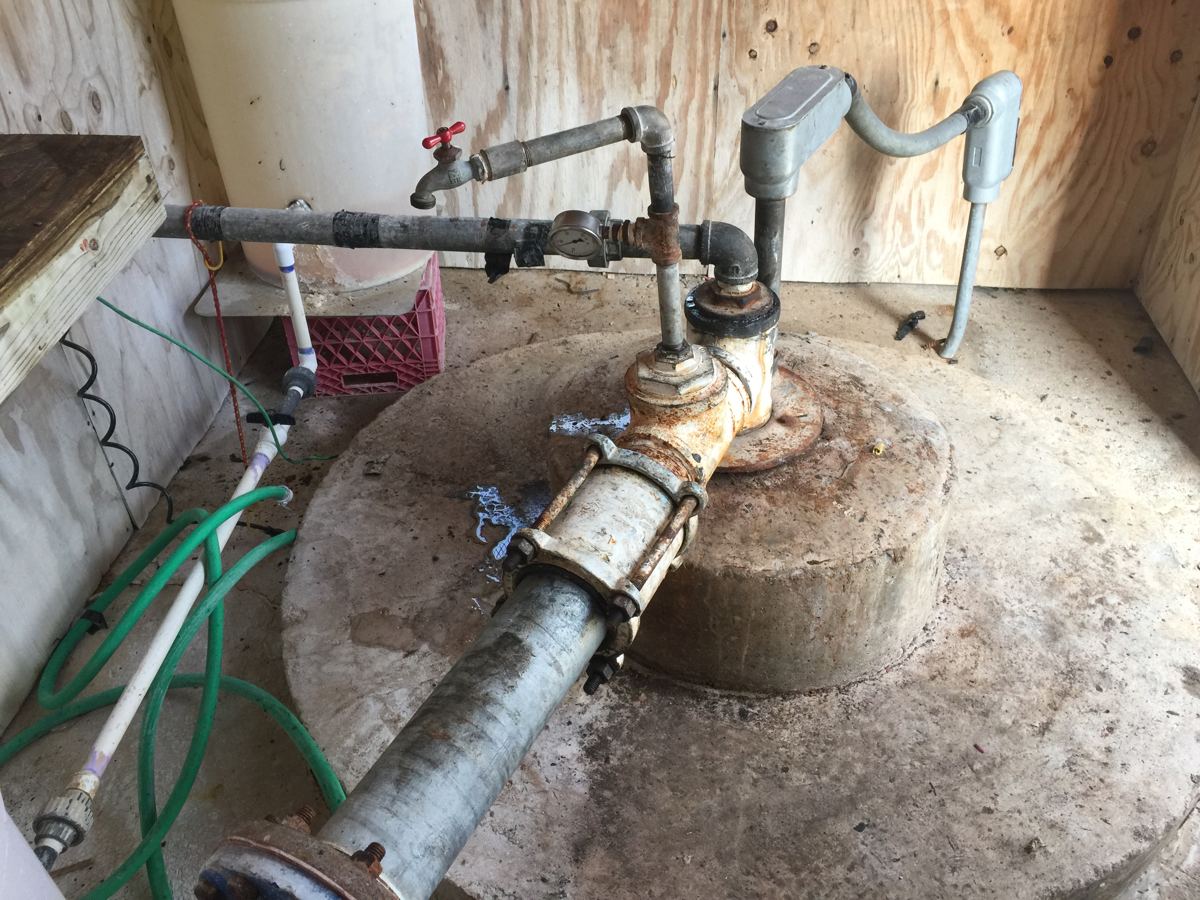 Inside a well house in Central Texas: the casing comes up through a concrete pad, with the discharge pipe, a pressure gauge and a hose bib. Photo: U.S. Geological Survey (public domain).
Which pump do you have?
| What you have | How to tell | What it means |
|---|---|---|
| Submersible, 3-wire | Pump down the well; a control box (usually gray) on the wall near the tank. | Capacitor and relay are in the box, above ground. Some “dead pump” calls are a box fault. |
| Submersible, 2-wire | No control box; wires go from the switch straight to the well. | Only the breaker and switch to check above ground. |
| Jet pump | Pump and motor above ground, by the tank or in a pit. | Lost prime, suction leaks and a bad foot valve are common. |
Tools: a voltage tester, a tire pressure gauge (for the tank’s air valve), and your tank pressure gauge.
Find your symptom
Easy = no wiring opened. Moderate = power off and verified dead, simple part swap. Pro = live electrical tests or pulling the pump.
| Symptom | Likely causes | How to check | Fix | Part | DIY |
|---|---|---|---|---|---|
| No water | Tripped breaker or fuse; switch contacts not closing; control box fault (3-wire); loose wiring; water level below the pump; jet pump lost prime. | Gauge below cut-in and pump silent = switch or power. Jet pump: is the casing full of water? | Reset breaker once. Replace a burned switch. Re-prime a jet pump. | Pressure switch; fuse | Easy → Moderate |
| Pump won’t shut off | Welded contacts or wrong setting; leak; low water level; worn pump; loose coupling; blocked intake; stuck check valve; low voltage; leaking drop pipe. | Does the gauge reach cut-out? Running toilets, wet ground over the line? | Fix leaks. Replace switch. Let a low well recover. Worn pump, drop-pipe leak: pull the pump. | Pressure switch | Easy → Pro |
| On/off every few seconds | Waterlogged tank or wrong air charge; bad switch; check valve stuck open; leaks; switch too far from tank; leaking foot valve (jet pump). | Power off, drain tank, read the air valve with a tire gauge. Water at the valve = failed bladder. | Set pre-charge 2 psi below cut-in. Replace a waterlogged tank or leaking check/foot valve. | Tank; check valve; foot valve | Easy → Moderate |
| Low pressure | Switch set low; low voltage; clogged intake or filter; stuck check valve; worn pump; low well yield. Jet pump: partial prime, plugged jet, suction lift too high. | Compare gauge with switch setting. Bypass the sediment filter. | Change the filter. Adjust the switch within the tank’s pre-charge. Low voltage, worn pump: pro. | Filter cartridge; pressure switch | Easy → Pro |
| Air or sputtering | Gassy well; water level drops and the pump draws air; jet pump suction leak. | Only after long water use (low well) or all the time? | Throttle output or lower the pump (pro). Fix suction leaks. Gassy well: ask a well pro. | — | Moderate → Pro |
| Breaker or overload trips | Voltage out of limits; control box hot from sun; bad box, motor or cable; worn pump; wire too small; box wrong HP or voltage; sand-bound pump. | Box HP/voltage must match the motor. Box must not be hot to touch (Franklin). | Shade or move the box. Everything else: pro. | Control box | Pro |
| Sand in water | Sand-bound pump (amps 3–6 times normal until the overload trips) (Franklin). Undeveloped well or pump too close to the bottom (Red Lion). | New, or since a pump swap? Worse at high flow? | Pro pulls the pump, corrects the setting, runs it until clear. | Sediment filter (protects fixtures only) | Pro |
| Hums or clicks, won’t start | Failed start capacitor or relay; bound pump; blown capacitor. Jet pump: impeller binding, thermal protector tripped. | 3-wire: power off, open the control box, look for a bulged or leaking capacitor. Jet pump: power off, does the shaft turn freely? | Capacitor replacement (pro recommended). A bound submersible must be pulled. | Capacitor kit; control box | Moderate → Pro |
Fixes, step by step
No water at all
- Reset the pump breaker once. Trips again? Call a pro.
- Power off and verified dead: open the pressure switch cover. Burned or pitted contacts: clean them or replace the switch (Franklin).
- Jet pump runs but nothing comes out: it lost prime. See how to prime a well pump. Vent the pump while filling, or water can’t get in (Goulds).
- Still nothing: see no water from well.
Pump won’t shut off
- Close all faucets. If the gauge stops short of cut-out, the pump can’t reach shut-off pressure.
- Look for leaks: running toilets, outdoor hydrants, wet spots over the buried line.
- Worn-pump test (Franklin): lower the switch setting. If the pump now shuts off, it may be worn.
- Well may be low? Shut the pump off and let it recover. Red Lion: never run the pump unless it is completely submerged. Its fix for a low-yield well, a flow restrictor with a relief valve, is installer work.
Pump turns on and off every few seconds
- Check the air charge. Power off, drain the tank through a nearby faucet, read the air valve with a tire gauge.
- Set it 2 psi below cut-in: 18 psi for 20/40, 28 psi for 30/50, 38 psi for 40/60 (Red Lion). Add air if low. See pressure switch settings.
- Water at the air valve? The bladder failed. Replace the tank; size it with the pressure tank size calculator.
- Switch location: within 1 ft of the tank (Red Lion). Jet pump within 4 ft of the tank (Goulds).
- Check valves: one stuck open won’t hold pressure. On a jet pump, check the foot valve.
Fix it soon: rapid cycling damages the motor. Franklin’s limits are 300 starts per 24 hours up to 3/4 HP, 100 for 1 HP and up, each run at least one minute.
Low pressure
Gauge normal while a tap runs? The problem is downstream: a clogged sediment filter (or one still in its plastic wrap), a softener or a fixture. Raise the switch setting only if the pump can reach the new cut-out, or it won’t shut off.
Breaker trips, sand, or pump hums
Don’t keep resetting. Apart from control box heat, these are pro jobs (limits in the table below).
- Sand: Franklin says don’t lower a pump “if sand may clog pump”.
- Hums, won’t start: a capacitor can test “good” on an ohmmeter and still be bad; Franklin calls these tests “not conclusive”. A blown capacitor may still hold a charge; have a certified electrician check it (Red Lion).
Numbers the manuals give you
For installers, not for live testing yourself.
| Check | Value | Source |
|---|---|---|
| Line voltage (Franklin motors) | Within ±10% of rated voltage | Franklin AIM |
| Voltage while running (Red Lion pumps) | Within ±5% of nameplate (±3% in Canada) | Red Lion guide |
| Tank pre-charge | 2 psi below cut-in: 18 / 28 / 38 psi for 20/40, 30/50, 40/60 | Red Lion guide |
| Pressure switch to tank | Within 1 ft (submersible) | Red Lion guide |
| Jet pump to tank | Within 4 ft | Goulds IM102R13 |
| Insulation resistance, motor + cable | ≥2.0 MΩ new; 0.5–2.0 MΩ good; <0.5 MΩ damaged | Franklin AIM |
| Max starts per 24 h, single-phase | 300 up to 3/4 HP; 100 for 1–5.5 HP | Franklin AIM |
| Minimum run time per start | 1 minute | Franklin AIM |
| Pump setting | At least 5 ft above the well bottom | Red Lion RL manual |
| Clear water after install | Within 30 minutes, or stop and correct | Red Lion RL manual |
| Control box location | 14–122 °F, out of direct sun, not in a damp pit | Franklin AIM |
| Relief valve with a flow restrictor | Must pass full pump flow at 75 psi | Red Lion guide |
When to call a pro
Call a licensed pump installer or electrician when:
- The breaker trips again after one reset.
- The fix needs live voltage or amp readings.
- The cause is down the well: worn pump, drop-pipe leak, damaged cable, or a water level that falls to the pump.
- You see sand or the water changes. Water Systems Council advises a licensed or certified contractor whenever the system is serviced.
Tell them: ask for Franklin’s preliminary tests (voltage, amps, insulation resistance, winding resistance) before pulling the pump. A low insulation reading can be a cable pinched at the well seal, not a dead motor. Replacing the pump? See well pump replacement cost.
Parts and related guides
- No water from well · How to prime a well pump · Pressure switch settings · Well pump replacement cost
- Tools: well pump size calculator · pressure tank size calculator · well pump wire size calculator
FAQ
Why is my well pump not working? Check the breaker, then the tank gauge. Below cut-in with the pump silent means power isn’t reaching it, often a failed pressure switch or (3-wire) control box. A jet pump that runs but delivers nothing has usually lost prime.
Why does my well pump turn on and off every few seconds? Usually the tank has lost its air charge or is waterlogged. Power off, drain the tank: the air valve should read 2 psi below cut-in, such as 28 psi on a 30/50 switch. Water at the valve means a failed bladder.
How do I know if it’s the pump or the pressure switch? Tank below cut-in, pump silent, burned switch contacts: likely the switch. Pump runs but can’t build pressure: the cause is past the switch. Confirming a dead motor takes insulation and winding tests by an installer before pulling the pump.
Sources
- Franklin Electric, AIM Manual 60 Hz Submersible Systems, 2026 edition (M1311 06-26) — Control Box, Pumptec Products, and Panel Environment and Frequency of Starts p.4; Rapid Cycling and Bound Pump (Sand-locked) p.11; 3-Wire Control Boxes p.12; System Troubleshooting p.26; Preliminary Tests and Insulation Resistance Readings p.28; Winding Resistance p.29; Control Box Checks p.31; Ohmmeter Tests p.32
- Red Lion, Troubleshooting Guide — shallow well jet pumps p.57; pre-charged pressure tanks p.58; 4” submersible well pumps pp.59–60
- Red Lion, 4-inch Deep Well Submersible Pump Owner’s Manual, 106720101 Rev. 003 (01/23) — installation cautions p.3, well test p.6, low-yielding well p.7, troubleshooting p.8
- Goulds Water Technology (Xylem), Jet Pumps Instruction Manual IM102R13 (June 2025) — electrical safety p.2, pump-to-tank distance p.4, priming p.6, troubleshooting p.12
- Water Systems Council, wellcare® information sheet “Pressure Tank Pre-charge
- Water Systems Council, Well Owner’s Manual — well maintenance p.14, licensed contractor note p.30
All sources checked 2026-10-05.
Method: we merged the troubleshooting tables from Franklin Electric, Red Lion and Goulds into one symptom chart, ordered checks from cheap to pro-only, and collected each manual’s test values in one table. Where makers differ (voltage tolerance), both are shown. Page references are in the sources above. We have not repaired pumps ourselves.
Editorial note: This page was researched and fact-checked by the County Road Home team against the manufacturer documents and public sources listed above. AI tools assisted with drafting; every number was checked by an editor before publishing. We are not licensed well contractors or electricians. For electrical work, use a licensed professional. Found an error? Email hello@countyroadhome.com. Last checked: 2026-10-05.