How the calculator works
- Pumping interval comes from the Penn State (Jarrett) table reprinted by the Kansas Department of Health and Environment (KDHE). It assumes 50 gallons per person per day and no garbage disposal. Between rows the calculator interpolates.
- Garbage disposal: interval × 2/3 (KDHE: about one-third sooner).
- Tank size unknown: the result shows the interval for 750, 1,000, 1,250 and 1,500 gallon tanks, all rows of the same table.
The full pumping table
Years between pumpings, year-round home, no garbage disposal. 5-person column from the Groundwater Foundation; the rest from KDHE Table 1.
| Tank (gal) | 1 person | 2 people | 3 people | 4 people | 5 people | 6 people | 8 people | 10 people |
|---|---|---|---|---|---|---|---|---|
| 500 | 5.8 | 2.6 | 1.5 | 1.0 | 0.7 | 0.4 | 0.2 | — |
| 750 | 9.1 | 4.2 | 2.6 | 1.8 | 1.3 | 1.0 | 0.6 | 0.3 |
| 900 | 11.0 | 5.2 | 3.3 | 2.3 | 1.7 | 1.3 | 0.8 | 0.5 |
| 1,000 | 12.4 | 5.9 | 3.7 | 2.6 | 2.0 | 1.5 | 1.0 | 0.7 |
| 1,250 | 15.6 | 7.5 | 4.8 | 3.4 | 2.6 | 2.0 | 1.4 | 1.0 |
| 1,500 | 18.9 | 9.1 | 5.9 | 4.2 | 3.3 | 2.6 | 1.8 | 1.3 |
| 1,750 | 22.1 | 10.7 | 6.9 | 5.0 | 3.9 | 3.1 | 2.2 | 1.6 |
| 2,000 | 25.4 | 12.4 | 8.0 | 5.9 | 4.5 | 3.7 | 2.6 | 2.0 |
| 2,250 | 28.6 | 14.0 | 9.1 | 6.7 | 5.2 | 4.2 | 3.0 | 2.3 |
| 2,500 | 31.9 | 15.6 | 10.2 | 7.5 | 5.9 | 4.8 | 4.0 | 2.6 |
Where the sources differ: 2,000 gal / 3 people: KDHE 8.0 years, Groundwater Foundation 8.1 years. We use 8.0. 2,500 gal / 8 people: KDHE prints 4.0 years, which breaks the pattern of the rest of the column (2,250 gal = 3.0). We show it as published and flag it.
Why the recommendations differ
| Source | Recommendation | Basis |
|---|---|---|
| U.S. EPA | Typically every 3–5 years; inspect at least every 3 years | Depends on household size, total wastewater, solids and tank size |
| Penn State Extension, 2023 (A. R. Jarrett) | "Every two to three years" | A family of four will fill the 300-gallon storage volume of a 1,000-gallon septic tank in about 1.5 years; adjusting for adults working outside the home a third of the time and children at school gives two to three years. |
| Penn State table (Jarrett), reprinted by KDHE | By tank size and household, from months to decades | 24 hours of detention, 50% digestion, 50 gallons per person per day |
If the table gives a long interval, have the tank checked well before then: EPA's 3-year inspection still applies.
Measure the sludge instead of guessing
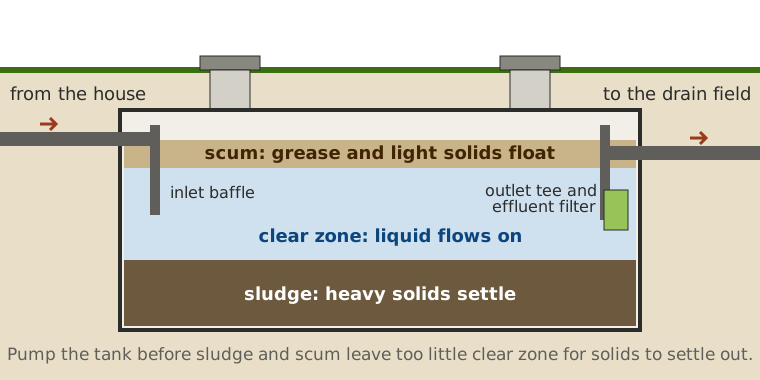
KDHE calls measuring the sludge and scum layers "the best way" to decide when to pump. Ask your pumper to measure and record them, and whether the tank could have waited; set your next date from that.
Minimum tank size by bedrooms
| Bedrooms | International Private Sewage Disposal Code | New York | Washington | Kansas | Penn State Extension |
|---|---|---|---|---|---|
| 1 | 750 | 1,000 | 1,000 | 1,000 | — |
| 2 | 750 | 1,000 | 1,000 | 1,000 | — |
| 3 | 1,000 | 1,000 | 1,000 | 1,000 | 900 |
| 4 | 1,200 | 1,250 | 1,000 | — | 1,250 |
| 5 | 1,425 | 1,500 | 1,250 | — | 1,400 |
| 6 | 1,650 | 1,750 | 1,500 | — | 1,550 |
| 7 | 1,875 | 2,000 | 1,750 | — | — |
| 8 | 2,100 | 2,250 | 2,000 | — | — |
- New York counts a garbage grinder as an extra bedroom and adds 250 gallons per bedroom over six. Washington adds 250 gallons per bedroom over four.
- Penn State starts at 3 bedrooms (900 gallons); smaller homes are shown that figure.
- KDHE advises a larger tank than the permit minimum whenever possible.
When this does not apply
- Heavy water use (well over 50 gallons per person a day): pump sooner than the table says (KDHE).
- Tanks under 500 or over 2,500 gallons, or more than 10 people: the calculator uses the table's edge.
- A measured sludge level from your pumper always beats the table.
Related
- On a private well as well as septic? Well water test kits vs a certified lab.
Frequently asked questions
How often should a septic tank be pumped?
EPA says every 3 to 5 years for most homes, with an inspection at least every 3 years. Penn State Extension says every 2 to 3 years. By the Penn State table, a 1,000-gallon tank serving 4 people needs pumping about every 2.6 years.
What size septic tank do I need for a 3 bedroom house?
1,000 gallons under the International Private Sewage Disposal Code and the New York, Washington and Kansas rules we checked; Penn State Extension lists 900. Your county permit office has the final number.
Does a garbage disposal mean more septic pumping?
Yes. Kansas health department guidance says to pump about one-third sooner with a garbage disposal, and New York counts a garbage grinder as an extra bedroom when sizing a new tank.
Sources
- Kansas Department of Health and Environment, Septic Tank Maintenance: A Key to Longer Septic System Life (Technical Guidance Document WMS 18-947), Table 1 · checked October 5, 2026
- The Groundwater Foundation, Get Pumped! Septic System Maintenance fact sheet (chart from Penn State Cooperative Extension) · checked October 5, 2026
- U.S. EPA, How to Care for Your Septic System (updated 2026-08-17) · checked October 5, 2026
- International Code Council, 2024 International Private Sewage Disposal Code, Section 802.7.1, Table 802.7.1 · checked October 5, 2026
- N.Y. Comp. Codes R. & Regs. tit. 10, app. 75-A, §75-A.6 (amended 2010-02-03) · checked October 5, 2026
- WAC 246-272A-0232 (effective 2025-04-01) · checked October 5, 2026
- A. R. Jarrett, Penn State Extension, Septic Tank Pumping (updated 2023-07-21) · checked October 5, 2026
Method: Pumping intervals come from the Penn State (Jarrett) table as published by the Kansas Department of Health and Environment and the Groundwater Foundation, interpolated for sizes between the published rows. Penn State Extension's 2023 two-to-three-year guidance is shown alongside. Tank minimums are copied from the code and extension tables listed. We have not inspected any septic systems.