Only jet pumps need priming; submersible pumps sit underwater. With power off, remove the priming plug, fill the pump and suction pipe (about 1 quart per 3 ft of pipe), refit the plug, open a faucet and start. No steady water after 2–5 minutes: stop and refill.
What we did: We compared the priming steps and time limits in five jet-pump manuals and turned them into one set of steps.
⚠️ Safety first. Turn off the pump breaker or disconnect before you remove any plug. Goulds warns that thermal overload protection “may allow an overheated pump to restart unexpectedly”. Don’t open plugs on a hot pump: hot water or vapor inside can be under pressure. Never run the pump dry; it damages the seal and impeller and voids the warranty. Never run it against a closed discharge: Everbilt warns the water can boil, with “risk of explosion”. Always open a faucet before you start.
Does your pump need priming?
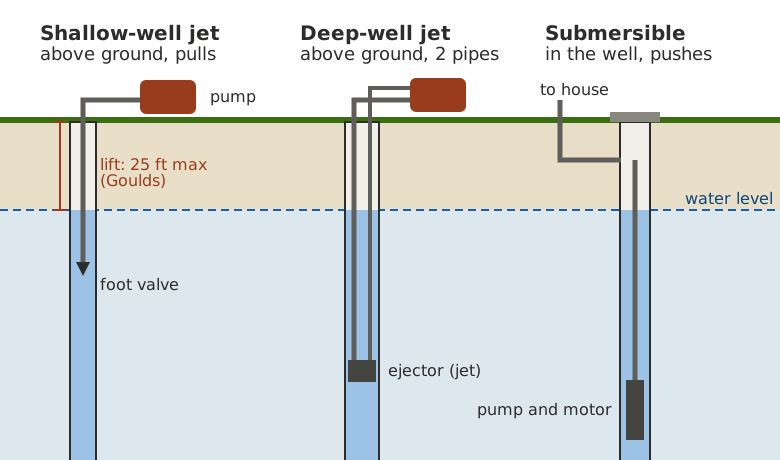
Our drawing, simplified and not to scale, after the pump-type figures in Goulds IM102 (Rev. 13, p.3).
| Pump type | How to recognize it | Needs priming? |
|---|---|---|
| Submersible | Pump down the well; in the house just a tank, switch, maybe a control box | No. It must not start until “completely submerged” (Grundfos). See no water from well. |
| Shallow-well jet pump | Above ground; one pipe to the well; water within 25 ft, including friction loss | Yes, whenever air gets in |
| Deep-well or convertible jet pump | Above ground; two pipes to the well, or one into a 2–3 in. casing (packer). Lifts over 25 ft (one maker: up to 90 ft) | Yes. Deep-well pumps “require a complete prime before starting” |
Prime a shallow-well jet pump
You need: clean water, about 1 quart per 3 ft of suction pipe (Red Lion; measure foot valve to pump, bring extra), a wrench or socket (not open-end), thread tape.
- Turn off the pump breaker.
- Open a faucet near the pump (and any discharge valve). Air needs a way out.
- Remove the priming plug on top, and any vent plug. Goulds pumps: pour through the plug or gauge bushing in the discharge tee, and remove the 1/8 in. vent plug between suction and discharge. “The water cannot go in unless the air can escape!” (Goulds)
- Fill the pump and suction pipe until water comes out of the priming hole (also through a priming tee, if there is one).
- Refit the plugs hand-tight.
- Breaker on. Goulds: open the faucet only a little, or the water is thrown out before the pump catches.
- Watch the time. No steady water within 2 minutes (Red Lion, Everbilt) or 5 minutes (Wayne)? Stop, refill, try again. Long suction pipes may need several tries.
- Water runs solid? Flush a few minutes, close the faucet, let the pump reach cut-out. Tighten the plugs.
- Check one cycle: it should start and stop at the switch settings (e.g. 30 and 50 psi on Everbilt’s factory switch).
Deep-well (convertible) jet pump: what’s different
It needs a pressure control valve on the discharge, before the first outlet, or it loses prime at peak use like a washing machine or bathtub (Goulds).
- Fill until water comes out of the vent hole: about 2 quarts per 3 ft of suction pipe (faster if you fill the pipes before connecting the pump). Vertical Goulds models: fill through the control valve’s gauge port; open the motor adapter’s vent plug.
- Close the control valve, then start. If primed, pressure builds almost at once.
- Slowly open the valve to maximum steady flow at the nearest tap; too far and the water stops. Red Lion’s target: casing gauge at about 25 psi; Goulds lists a setting per model and jet.
Time limits, manual by manual
| Manual | Run before stopping | Repeats | Stop and look for a leak | Total time |
|---|---|---|---|---|
| Red Lion RJS-PREM, shallow, in-line check valve | 2 minutes | One per ~5 ft of suction pipe; “about 2–6 times” | After 8 tries | — |
| Red Lion RJS-PREM, foot valve | Pumps at once; re-prime if not steady in 2 minutes | Once more | If a second priming fails | — |
| Red Lion RJC-PREM, deep well | Pressure builds at once | — | — | 5–15 minutes, by distance to water |
| Wayne SWS / CWS | 5 minutes. “Do not allow pump to get hot” | Continue, “pausing every 5 minutes to cool pump body” | — | “A few minutes” |
| Everbilt shallow well | 2 minutes | “Several times” | — | Up to 15 minutes at 25 ft of lift |
No manual? Use the strictest: 2 minutes per try, 8 tries total. A pump on air heats fast and ruins its seal.
Pump keeps losing prime?
“Pumps do not ‘hold’ prime, piping systems and check valves do.” (Goulds) Worn seals or a faulty air volume control can also cause it (Water Systems Council).
| Cause | How to check | Fix |
|---|---|---|
| Suction air leak | Air spurting at taps; low vacuum; shaving cream on joints gets sucked in | Reseal joints; double-clamp barbed poly fittings |
| Foot or check valve leaking | Prime lost overnight; pump starts by itself | Clean or replace the valve |
| Water drops below the foot valve | Air on long draws; works after resting | Lower the foot valve or restrict output. Deep-well jets: tailpipe (Goulds: 34 ft; Red Lion: up to 30 ft) |
| Lift over 25 ft | Vacuum near 22 in. Hg; drought | Deep-well jet or submersible |
| Humps or dips in the suction line | Line rises then drops to the pump | Re-run it level or sloping up to the pump |
| Filter on the suction side | Cartridge filter before the pump | Remove it (Goulds: none on the suction side) |
| Deep-well control valve missing or misset | Loses prime with several taps open | Install or adjust it |
| Packer leathers not sealing | Packer system won’t hold prime | Clean, smooth casing; soak leathers in water, never grease |
Not sure which? On a shallow-well pump, fit a compound vacuum/pressure gauge in the 1/8 in. port between suction and discharge (Goulds):
| Gauge reading | Meaning | Likely cause |
|---|---|---|
| 22 in. Hg or more | Blockage or too much lift | Suction pipe in mud; foot or check valve stuck closed; lift past the limit |
| Low or 0 | Air getting in | Suction pipe not under water; leak at joints or unions |
| Needle jumps | Intermittent air | Gassy well; air leak; well can’t keep up with the pump |
1 in. Hg = 1.13 ft of lift (20 in. = 22.6 ft). Limit at sea level: 25 ft, or 22 in. Hg, minus 1 ft per 1,000 ft of elevation. Red Lion’s 25 ft includes drawdown and is “less at high altitudes”.
After winter or a new seal: re-prime before use (leave the drain plug out until then): “Prime the pump, start, check for leaks.”
When to call a pump contractor
- No prime after the manual’s limit (e.g. 8 tries, Red Lion shallow-well).
- Vacuum 22 in. Hg or more, or water below about 25 ft: you need a different pump.
- The pump overheated or ran dry for long (seal and impeller damage).
- Any motor wiring: electrician or qualified technician.
Related
- No water from well · Well pump troubleshooting
- Jet pump at its limit? Well pump size calculator · Well pump replacement cost
FAQ
Do submersible well pumps need to be primed? No. It sits underwater and has no suction pipe to fill. No water? Check power, the pressure switch, the check valve and the water level.
How long does it take to prime a well pump? Usually a few minutes: 2 minutes per attempt, up to 15 minutes total at 25 ft of lift, or 5–15 minutes for deep wells. Stop between attempts.
Why does my well pump keep losing prime? Usually a suction-pipe air leak or a leaking foot or check valve. Also: water dropping below the foot valve or past 25 feet of lift, or a misset deep-well control valve.
Sources
- Xylem / Goulds Water Technology, Jet Pumps Installation, Operation and Troubleshooting Manual, IM102 Rev. 13 (June 2025) — pump types and 25 ft lift p.3; suction piping, foot valve, throttling p.4; deep well twin pipe/packer and pressure control valve p.5; tank pre-charge, relief valve, priming shallow and deep well p.6; never run dry, seasonal draining p.7; vacuum gauge and tailpipe p.11; troubleshooting p.12
- Red Lion, RJS-PREM Series Shallow Well Jet Pump Owner’s Manual (106905101) — 25 ft lift p.1; hot-pump and run-dry warnings p.2; relief valve p.4; GFCI and low-pressure cut-off p.5; priming p.6; draining p.7; troubleshooting p.9
- Red Lion, RJC-PREM Convertible Jet Pump Owner’s Manual (106905103) — application 25 ft / 90 ft p.4; foot valve and tailpipe p.5; priming shallow and deep p.13; troubleshooting p.15
- Wayne, SWS Shallow Well Jet Pump Operating Instructions and Parts Manual (670005-001 B, 08/18) — description (25 ft), priming section, troubleshooting chart
- Wayne, CWS Convertible Well Jet Pump Operating Instructions and Parts Manual (640003W-001 D, 08/20) — shallow well installation p.5; priming shallow and deep well p.10; troubleshooting chart p.15
- Everbilt, Shallow Well Jet Pump Use and Care Guide (AUTOJ100A2/A3, J100A3, J200A3) — application and foot valve note p.4; priming and winterizing p.13; troubleshooting pp.14–15
- Grundfos, SQ/SQE Installation and operating instructions, 96160909 (11.2024) — §5 Start-up p.15
- Franklin Electric, AIM Manual 60 Hz Submersible Systems, 2026 edition (M1311 06-26) — Well Applications (cooling flow) p.8
- Water Systems Council, Water Well Care Hotline FAQs (“I have to prime it every other day”)
All sources checked 2026-10-05.
Method: we merged the priming instructions in five jet pump manuals into one set of steps, keeping each maker’s limits side by side instead of averaging them. Page references are in the sources above. We have not primed or tested pumps.
Editorial note: This page was researched and fact-checked by the County Road Home team against the manufacturer documents and public sources listed above. AI tools assisted with drafting; every number was checked by an editor before publishing. We are not licensed well contractors or electricians. For electrical work, use a licensed professional. Found an error? Email hello@countyroadhome.com. Last checked: 2026-10-05.