How the calculator works
Total dynamic head (TDH) = pumping water level + rise to tank + cut-out psi × 2.31 + friction loss.
- Friction = (drop pipe + horizontal pipe + fittings) × loss per 100 ft at your flow, from Goulds' PVC table or Centennial's PE table, interpolated between rows.
- Demand is Goulds' minimum pump size for a seven-minute peak; outdoor watering is not included.
- Don't know? An unknown height is left out and named in the result; unknown material uses whichever table loses more; unknown pipe size shows every size.
- It does not pick horsepower: that needs a specific pump's curve.
Worked example
2 bathrooms (14 GPM), pumping level 100 ft, tank 10 ft above the well head, 120 ft drop pipe + 100 ft to the house in 1-1/4 in PE, 2 elbows, pitless adapter, 1 check valve, 40/60 switch:
| Lift: 100 + 10 | 110.0 ft |
| Pressure: 60 psi × 2.31 | 138.6 ft |
| Friction: (220 ft + 26.6 ft of fittings) × 3.16 ft per 100 ft | 7.8 ft |
| TDH | 256.4 ft |
In 1 in Schedule 40 PVC the friction would be 31.3 ft and TDH 279.9 ft.
GPM by number of bathrooms
Goulds TTECHWP p.6, "normal seven minute peak demand" in gallons per fixture.
| Outlet | Flow (GPM) | 1 bathroom | 1½ bathrooms | 2 to 2½ bathrooms | 3 to 4 bathrooms |
|---|---|---|---|---|---|
| Shower or bathtub | 5 | 35 | 35 | 53 | 70 |
| Lavatory | 4 | 2 | 4 | 6 | 8 |
| Toilet | 4 | 5 | 10 | 15 | 20 |
| Kitchen sink | 5 | 3 | 3 | 3 | 3 |
| Automatic washer | 5 | – | 18 | 18 | 18 |
| Dishwasher | 2 | – | – | 3 | 3 |
| Seven-minute peak (gal) | 45 | 70 | 98 | 122 | |
| Minimum pump size | 7 GPM | 10 GPM | 14 GPM | 17 GPM |
Friction loss per 100 ft: PE vs Schedule 40 PVC
Feet of head per 100 ft of pipe. PE = Centennial's psi × 2.31. Dash = outside the published table. * = interpolated.
| GPM | 3/4 in PE | 1 in PE | 1-1/4 in PE | 1-1/2 in PE | 2 in PE | 3/4 in PVC | 1 in PVC | 1-1/4 in PVC | 1-1/2 in PVC | 2 in PVC |
|---|---|---|---|---|---|---|---|---|---|---|
| 5 | 5.68 | 1.76 | 0.66* | 0.38* | 0.21* | 6.33 | 1.92 | 0.51 | 0.24 | 0.08* |
| 7 | 10.60 | 3.16 | 0.93* | 0.53* | 0.29* | 12.00* | 3.63* | 0.95* | 0.44* | 0.14* |
| 10 | 20.44 | 6.38 | 1.62 | 0.76 | 0.42* | 25.98 | 6.88 | 1.78 | 0.83 | 0.25 |
| 12 | 28.64 | 8.89 | 2.33 | 1.06 | 0.50* | 35.46* | 9.98* | 2.57* | 1.19* | 0.36* |
| 14 | 38.12 | 11.78 | 3.16 | 1.50 | 0.58* | 44.94* | 13.08* | 3.36* | 1.56* | 0.47* |
| 15 | 43.20 | 13.31 | 3.60 | 1.76 | 0.62* | 49.68 | 14.63 | 3.75 | 1.74 | 0.52 |
| 17 | — | 17.13* | 4.53* | 2.14* | 0.71* | 64.58* | 18.81* | 4.81* | 2.22* | 0.66* |
| 20 | — | 22.87 | 5.91 | 2.73 | 0.83 | 86.94 | 25.07 | 6.39 | 2.94 | 0.86 |
| 25 | — | 34.42 | 8.94 | 4.27 | 1.27 | — | 38.41 | 9.71 | 4.44 | 1.29 |
| 30 | — | — | 12.61 | 5.91 | 1.73 | — | — | 13.62 | 6.26 | 1.81 |
1 in pipe at 10 GPM, per 100 ft: Goulds Sch 40 PVC 6.88 ft; Centennial SIDR PE 2.76 psi = 6.38 ft; Red Lion's generic 'plastic pipe' table 6.31 ft (convertible jet pump manual 106905103 p.10). Red Lion does not separate PVC from PE, so the calculator uses the two material-specific tables. Between published flow rows the calculator interpolates in a straight line. Friction rises faster than linearly with flow, so this slightly overstates the loss: Goulds' own worked example gives 3.56 ft per 100 ft of 1 in pipe at 7 GPM, where interpolating its table gives 3.64 ft. Red Lion: friction in the line from pump to house should "never exceed 20 ft" of head.
Fittings, in equivalent feet of pipe
| Fitting | 3/4 in | 1 in | 1-1/4 in | 1-1/2 in | 2 in |
|---|---|---|---|---|---|
| 90° elbow | 2 | 2.7 | 3.5 | 4.3 | 5.5 |
| Pitless adapter (tee, side inlet or outlet) | 4.5 | 5.7 | 7.6 | 9 | 12 |
| In-line spring check valve or foot valve | 6 | 8 | 12 | 14 | 19 |
| Swing check valve | 5 | 7 | 9 | 11 | 13 |
| Gate valve, fully open | 0.5 | 0.6 | 0.8 | 1 | 1.2 |
Jet or submersible: depth limits in the manuals
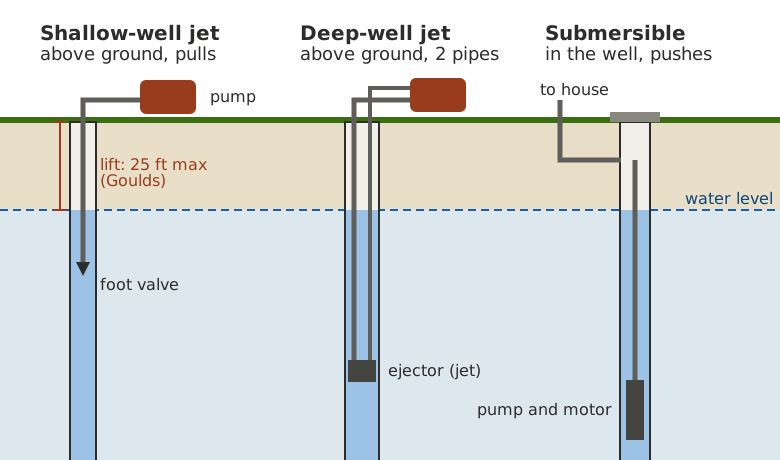
| Pump type | Depth limit in the manual | Source |
|---|---|---|
| Shallow-well jet | 25 ft total suction lift, vertical lift plus suction-pipe friction; deduct 1 ft per 1,000 ft of altitude | Goulds IM102 pp.3, 11 |
| Convertible jet, deep-well setup | Down to 90 ft (less at high altitude) | Red Lion 106905103 p.4 |
| Deep-well jet (twin pipe or packer) | Over 25 ft; Chart 1 lists depths to the jet up to 200 ft (larger SJ/HSJ models); J-series convertibles stop at 90–140 ft | Goulds IM102 pp.3, 8 |
| Submersible | No suction limit: "a submersible should be used when source will allow" | Goulds TTECHWP p.53 |
When this calculator does not apply
- Choosing horsepower: read a maker's pump curve with the GPM and TDH here, or ask a pump installer.
- Mixed pipe sizes: run each section, or use the smaller size.
- Uphill fixtures far from the tank: add their rise and friction (Goulds).
- Low-yield wells: if demand is above the well yield, a well contractor can size the pump to the well or add storage.
Related
- Next step: pressure tank size calculator for the flow you chose.
- Raising the switch from 30/50 to 40/60 adds 23.1 ft of head: pressure switch settings.
- Power outages: what size generator for a well pump.
- Replacing a pump: well pump replacement cost.
Frequently asked questions
How many GPM do I need from my well pump?
Goulds puts it at 7 GPM for 1 bathroom, 10 for 1½, 14 for 2 to 2½ and 17 for 3 to 4, from a seven-minute morning peak. Add garden hoses (3 to 6 GPM each) if they run at the same time.
How do you calculate total dynamic head for a well pump?
Add the pumping water level, the rise from well head to pressure tank, the cut-out pressure × 2.31 ft, and pipe friction. Friction comes from a published table per 100 ft for your pipe size, material and flow.
When do you need a submersible instead of a jet pump?
Shallow-well jet pumps reach about 25 ft of total suction lift, less 1 ft per 1,000 ft of altitude. Deep-well jets reach 90 ft in one maker's manual and up to 200 ft in another. Deeper than that, use a submersible.
Sources
- Goulds Water Technology (Xylem), Water Products Technical Data and Pump Fundamentals TTECHWP R6 (December 2022): p.1 Sch 40 plastic pipe friction loss; p.4 fittings; p.6 pump selection for private residences; p.21 formulas; pp.49–53 demand, suction lift, 2.31 ft per psi · checked October 5, 2026
- Centennial Plastics, Standard Polyethylene Pipe (SIDR): flow velocity and pressure loss from friction per 100 ft of pipe (psi) · checked October 5, 2026
- Goulds Water Technology (Xylem), Jet Pumps Installation, Operation and Troubleshooting Manual IM102 Revision 13 (June 2025), p.3 (selecting the system, 25 ft), p.8 (Chart 1 depth to jet), p.11 (suction lift, altitude) · checked October 5, 2026
- Red Lion, Convertible Jet Pump Owner's Manual 106905103, p.4 (application: 25 ft shallow, 90 ft deep) · checked October 5, 2026
- Red Lion, Convertible Jet Pump Owner's Manual 106905103, p.10 (Table 1 friction loss for plastic pipe; 20 ft service-line friction limit) · checked October 5, 2026
- Red Lion, Troubleshooting Guide, p.59 (low-yield well, flow restrictor) · checked October 5, 2026
- Amtrol, Sizing the Well-X-Trol 9017-102 (03/19), p.2 (psig × 2.31 = feet of head) · checked October 5, 2026
Method: Demand comes from the Goulds bathroom table; friction loss from the Goulds Schedule 40 PVC table and the Centennial Plastics SIDR polyethylene table, interpolated between published flows; fittings from the Goulds equivalent-length table; pump-type depth limits from the Goulds IM102 and Red Lion convertible jet manuals. The calculator does not choose horsepower because that needs a specific pump's curve. We have not installed or tested any pumps.