Common well pressure switch settings are 20/40, 30/50 and 40/60 psi, each with a 20 psi differential. First set the empty tank's precharge 2 psi below the new cut-in: 28 psi for 30/50, 38 psi for 40/60. About 3½ range-nut turns shift both points 10 psi.
What we did: We worked out the tank drawdown for each common switch setting and checked it against Amtrol's published tank figures.
⚠️ Safety first. The switch terminals carry 115 V or 230 V. Turn the pump breaker off before you remove the cover, and check the terminals with a non-contact tester or meter. Franklin warns that contact with hazardous voltage “could result in death or serious injury”. Amtrol says to turn off pump power and release all water pressure before working on the tank, and that only qualified professionals should check or re-charge tank precharge. Not comfortable? A licensed pump installer or electrician can do it in one visit.
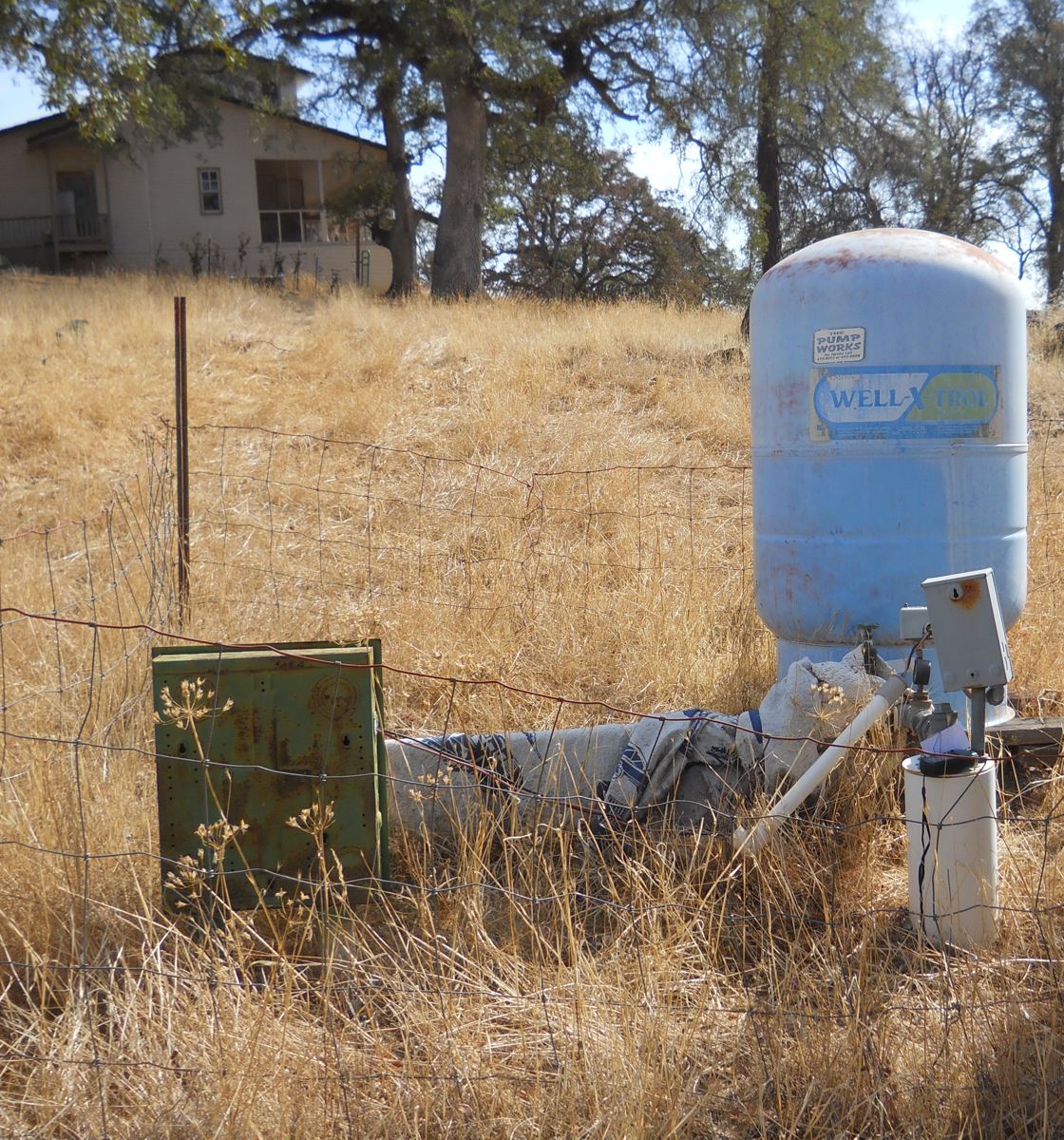 A pressure tank and pressure switch at an outdoor wellhead in rural California. Photo: Goldrath, U.S. Geological Survey (public domain).
What the numbers mean
“40/60” means the pump starts (cut-in) at 40 psi and stops (cut-out) at 60 psi. The gap is the differential. Precharge is the air pressure in the tank, read with the tank empty of water (Amtrol). Range is the span the cut-out can be set within, e.g. 20–65 psi on a Square D 9013FSG2.
20/40 vs 30/50 vs 40/60
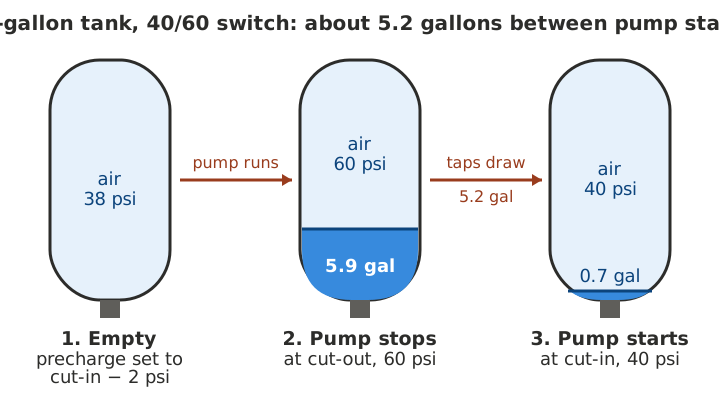
Our drawing. Volumes computed with Boyle’s law (absolute pressure = gauge + 14.7) for a 20-gallon tank, precharge 2 psi below cut-in; tank shape simplified.
Higher settings: stronger pressure, but less water between pump starts.
| Setting | Differential | Tank precharge (cut-in − 2 psi) | Drawdown factor, our Boyle’s-law calc | Factor implied by Amtrol’s published drawdown | Amtrol drawdown, 20 gal tank (WX-202) | Amtrol drawdown, 44 gal tank (WX-250) |
|---|---|---|---|---|---|---|
| 20/40 | 20 psi | 18 psi | 0.34 | Not published in the Amtrol sheets checked | — | — |
| 30/50 | 20 psi | 28 psi | 0.30 | 0.31 | 6.2 gal | 13.6 gal |
| 40/60 | 20 psi | 38 psi | 0.26 | 0.27 | 5.4 gal | 11.8 gal |
| 50/70 | 20 psi | 48 psi | 0.23 | 0.235 | 4.7 gal | 10.4 gal |
- Drawdown = water per pump cycle = factor × tank volume. Our factor = precharge × (1/cut-in − 1/cut-out), in absolute psi (gauge + 14.7); for 30/50, 42.7 × (1/44.7 − 1/64.7) = 0.295.
- Amtrol’s factors (0.31 / 0.27 / 0.235, same for every model WX-102 to WX-350) run about 1 point higher because its sizing sets precharge equal to cut-in (44.7 × (1/44.7 − 1/64.7) = 0.309). With the 2 psi gap, expect about 4–5% less.
- 30/50 → 40/60, 20-gallon tank: 6.2 → 5.4 gallons, roughly 13% less, so about 15% more pump starts. Size a tank with the pressure tank size calculator.
- New tank? Well-X-Trol tanks ship at 38 psig (Amtrol), right for 40/60. For 30/50, let air out to 28 psi first.
- Drive box instead of a switch? Use the drive’s own table. Franklin: 50 psi system → 35 psi precharge, 60 psi → 42 psi, ±2 psi (70% of system pressure, SubDrive Connect manual).
Step 1: Set the tank precharge
Amtrol: set precharge “2 psig below the pressure switch pump cut-in setting” (Square D gives the same rule). Change the switch without this and the tank delivers less water per cycle.
- Turn off power to the pump at the breaker.
- Open a faucet and drain the tank. Amtrol: “Make adjustments only when the tank is empty of water and the system is off”.
- Read the air valve with a tire gauge.
- Add air (bike pump or compressor) or let air out until it reads 2 psi below the new cut-in.
Do not add air if the tank has lost air before, shows corrosion, or the pump short-cycles more than when new. Amtrol warns re-pressurizing such a tank “could result in rupture or explosion”. Replace it. Water from the air valve means a leaking bladder; see pump troubleshooting.
Step 2: Adjust a Square D 9013FSG2
The catalog number’s end code is the factory setting: J20 = 20/40, J21 = 30/50, J24 = 40/60.
Square D limits: cut-out 20–65 psi (34–65 with M4), cut-in 5–45 psi (19–45 with M4), differential 15–30 psi, maximum 65 psi; motor up to 1.5 HP at 115 V, 2 HP at 230 V.
40/60 fits; 50/70 does not. Square D: pressure “should never exceed the upper limit of the range” (it shortens diaphragm life). For higher settings, fit a switch with the right range, such as the 9013FYG (25–80 psi cut-out).
Both nuts take a 3/8-inch nut driver or socket.
| Nut | Turn clockwise | Turn counterclockwise | Effect |
|---|---|---|---|
| Range nut (R) | Raises cut-in | Lowers cut-in | Cut-out moves by the same amount; differential stays the same |
| Differential nut (D) | Raises cut-out | Lowers cut-out | Cut-in does not change |
| From | To | Turn range nut clockwise |
|---|---|---|
| 20/40 | 30/50 | 3½ turns |
| 30/50 | 40/60 | 3½ turns |
| 20/40 | 40/60 | 8 to 8½ turns |
Roughly 3 psi per turn, not exactly linear. Finish by the gauge.
Steps:
- Watch the gauge through one cycle. Note where the pump starts and stops.
- Turn off the pump breaker. Remove the switch cover. Check for water leaking at the diaphragm or flange and for frayed wires.
- Set the tank precharge for the new cut-in (Step 1).
- To move both points: turn the range nut clockwise to raise, counterclockwise to lower.
- To change only the cut-out: turn the differential nut.
- Replace the cover, restore power, run a faucet until the pump starts, close it, note where it stops. Adjust in small steps.
Square D: do not sand, file or chemically clean pitted contacts. If the switch won’t respond, check its pressure port for silt or lime.
Pump won’t shut off after raising it?
Each psi costs the pump 2.31 feet of head (Amtrol); 30/50 → 40/60 adds 23.1 feet. A worn or undersized pump stalls below cut-out and runs nonstop, moving little water. Franklin’s 4-inch motors (2 hp and smaller) need cooling flow “greater than zero”.
- Test (Franklin): lower the setting. If the pump now shuts off, worn pump parts are likely. Also check for leaks and open faucets (Square D).
- Before raising it, run your numbers in the well pump size calculator. Barely reaching 50 psi now? Stay at 30/50.
- Cycling too often is the opposite problem. Franklin: at least one minute per start, under 300 starts a day for single-phase motors up to 0.75 HP, 100 for 1–5.5 HP.
Switch with a side lever (Form M4)
An M4 switch has a side lever. It shuts the pump off if pressure drops about 10 psi below cut-in, e.g. when the well runs low (Square D). That point follows the cut-in.
- To restart, hold the lever at Run until pressure rises to within 10 psi of cut-in.
- If it trips again, the well is low. Square D: don’t use the lever again until the well recharges. See no water from well.
FAQ
What should my pressure tank be set at for 40/60? 38 psi, read with the tank empty and the pump off. The rule is 2 psi below cut-in: 28 psi for 30/50, 18 psi for 20/40.
How many turns to go from 30/50 to 40/60? About 3½ clockwise turns of the range nut, per Square D’s guideline; 8 to 8½ turns from 20/40 to 40/60. Treat it as a start and finish with the gauge.
Is 40/60 better than 30/50? About 10 psi more at the taps, but roughly 13% less water per cycle, and the pump needs 23 more feet of head. Only if your pump has head to spare.
Sources
- Schneider Electric / Square D, Data Bulletin 9013DB0701 (12/2007), “Preventive Maintenance and Troubleshooting Guidelines for Class 9013F and 9013G Pressure Switches”, pp.1–3 (adjusting, turn table), pp.4–5 (troubleshooting), p.7 (FAQ on low-pressure cut-off)
- Square D, Catalog “9013 PUMPTROL Commercial Pressure Switches Type F and Type G” (January 2007), p.6 (definitions), p.8 (electrical ratings), pp.10–11 (FSG ranges, pressure codes, Form M4)
- Square D, “Pumptrol FSG Pressure Switch” product sheet 9013HO0601 (2006), p.2 (catalog numbers FSG2J20 / J21 / J24)
- Amtrol, Well-X-Trol Residential Installation & Operation Instructions, 9016-868 MC10185 (02/19), p.2 (warnings, 150 psig, relief valve), p.3 (precharge 2 psig below cut-in), p.6 (adjusting precharge after installation)
- Amtrol, Well-X-Trol quick-sizing card MC7025 (03/24), p.1 drawdown table at 30/50, 40/60, 50/70 psig; factory precharge 38 psig
- Amtrol, “Sizing the Well-X-Trol” 9017-102 (03/19), pp.2–4 (psig × 2.31 = feet of head; acceptance factor formula)
- Franklin Electric, AIM Manual 60 Hz Submersible Systems, 2026 edition (M1311 06-26) — p.4 (Frequency of Starts), p.8 (Water Temperature and Flow, cooling-flow note), p.26 (System Troubleshooting), p.31 (Control Box Checks, hazardous voltage warning)
- Franklin Electric, SubDrive/MonoDrive Constant Pressure Controller Installation Manual M1560 (225417101 Rev 7, 05-13) — Pressure Tank, Table 5 “Pressure Tank Pre-charge” p.29
- Franklin Electric, SubDrive Connect Owner’s Manual 226203103 (©2024) — Minimum Pressure Tank and Supply Pipe Sizing p.15 (pre-charge 70% of targeted system pressure)
All sources checked 2026-10-05.
Method: we combined Square D’s switch ranges, pressure codes, turn counts and M4 behavior with Amtrol’s precharge rules and drawdown volumes into one settings table. We calculated drawdown factors with Boyle’s law (absolute pressure = gauge + 14.7), set them next to factors back-calculated from Amtrol’s published drawdowns, and explained the gap. We also checked the pump-side limits in Franklin’s manuals and converted switch pressure to feet of head. Page references are in the sources above. We have not adjusted or tested these switches ourselves.
Editorial note: This page was researched and fact-checked by the County Road Home team against the manufacturer documents and public sources listed above. AI tools assisted with drafting; every number, spec and rule was checked by an editor before publishing. We are not licensed well contractors or electricians — for electrical, gas and water-safety work, use a licensed professional. Found an error? Email hello@countyroadhome.com and we will review it within 7 days. Last checked: 2026-10-05