Match equipment to each lab result. EPA limits: nitrate 10 mg/L (as N), arsenic 0.010 mg/L, coliform bacteria zero. Nuisance guidelines: iron 0.3 mg/L, manganese 0.05 mg/L, pH 6.5–8.5. Health problems usually need point-of-use or disinfection equipment certified to a specific NSF/ANSI standard.
What we did: We built one decision table from EPA limits and state and university guidance: each test result, the treatment that matches it and the certification to look for.
⚠️ Health results come before equipment. If a test shows coliform bacteria or E. coli, or nitrate, arsenic or lead near or above the EPA numbers below, CDC says to consider bottled water or another source for drinking and to call your local health or environmental department. Do not boil water for nitrate or arsenic: boiling concentrates them (Minnesota Department of Health; Water Systems Council). Do not use high-nitrate water to mix formula for babies under six months (MDH). Retest at a state-certified lab before you buy anything, and again after installation.
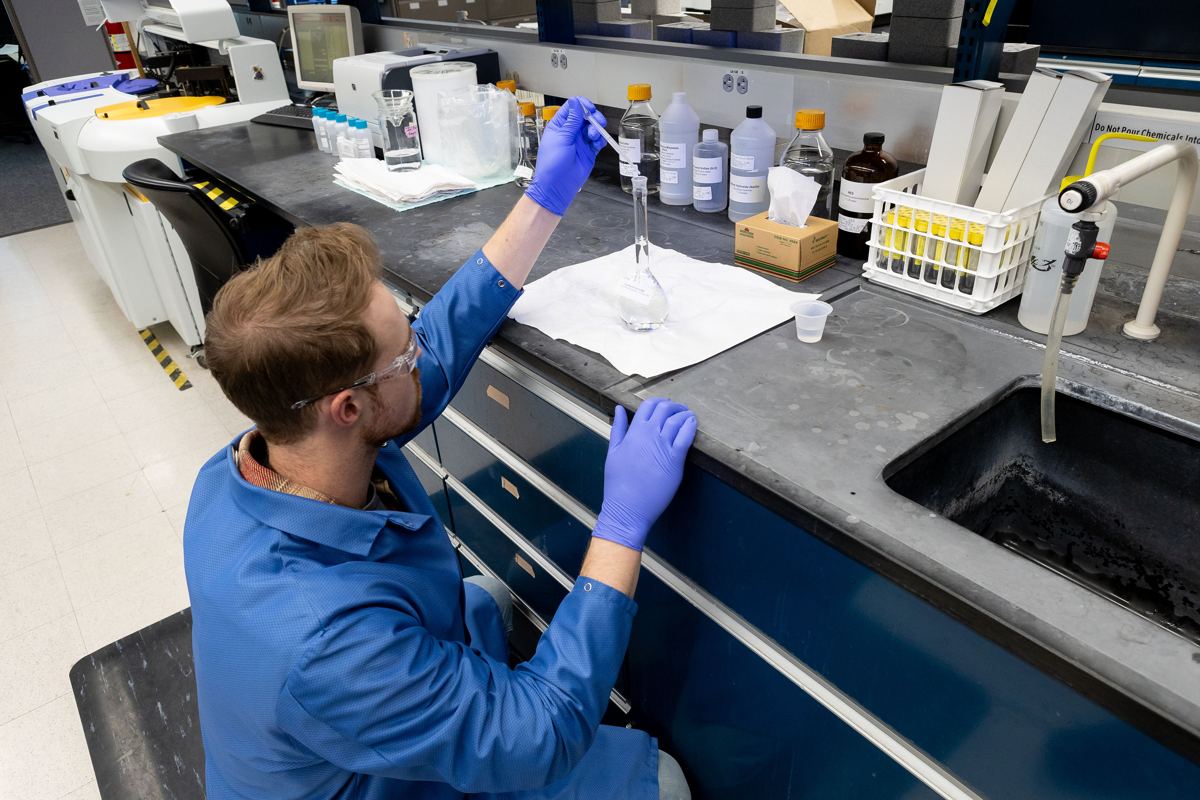 A chemist at the USGS National Water Quality Laboratory measuring a water sample. Photo: U.S. Geological Survey National Water Quality Laboratory (public domain).
Test first
EPA does not regulate private wells; testing is up to you. Ask a state-certified lab for:
- Yearly basics (CDC): total coliform bacteria, nitrate, TDS, pH.
- For equipment: iron, manganese, hardness, alkalinity, sulfate, chloride.
- Rotten-egg smell: hydrogen sulfide (on site or stabilized sample).
- Tea-colored water: tannins (the lab must subtract iron’s false positive).
- Arsenic, with speciation: arsenic III and V need different treatment.
- Lead and copper: first water out in the morning.
Penn State warns some vendors use “colorful home water tests” to pressure homeowners; confirm at an independent lab. See the well water test kit guide, or check a report in the well water test results tool.
Match equipment to your results
Primary limits are about health; secondary limits are about taste, odor and stains. Use both as guidelines for a well.
| Problem | EPA number | Treatment (source) | NSF/ANSI to look for |
|---|---|---|---|
| Sediment, cloudiness | None | Sediment cartridge (rated in microns) or backwashing media filter (VCE) | None named. |
| Hardness (scale, soap film) | None. Penn State: >7.0 gpg (>120 mg/L) is hard; 1 gpg ≈ 17 mg/L | Water softener (VCE; Penn State) | 44, or IAPMO/ANSI Z601 for scale-reduction devices (EPA WaterSense) |
| Iron (orange stains, metallic taste) | 0.3 mg/L, secondary | Softener for a little dissolved iron; for more, oxidizing filter, aeration + filter, or chemical oxidation + filter (Penn State; Nebraska) | Media often have only NSF/ANSI 61 = material safety, not removal (Inversand; Clack) |
| Manganese (black specks) | 0.05 mg/L, secondary. Health advisory 0.3 mg/L (Penn State; Nebraska) | Softener (Nebraska: below 0.5 mg/L) or oxidizing filter | Wisconsin DHS: NSF/ANSI 44 (softeners). Nebraska: NSF and WQA “do not … certify treatment units for manganese” |
| Hydrogen sulfide (rotten eggs) | None. Odor: 3 TON, secondary | Penn State: carbon below about 1.0 mg/L; aeration to about 2 mg/L; oxidizing filter to 2–3 mg/L; chlorination at any level, most often above 6.0 mg/L. Hot water only: water heater anode rod | None named |
| Low pH (blue-green stains) | 6.5–8.5, secondary | Neutralizing filter (calcite, magnesium oxide; adds hardness) or soda ash feed (doesn’t) (Penn State; VCE) | None named |
| Coliform / E. coli | Goal zero. Penn State: <1 colony/100 mL | First disinfect the well, find the source, retest (MDH). Ongoing: UV or continuous chlorination (VCE) | UV: 55 Class A. Class B covers only non-disease-causing bacteria (NSF) |
| Nitrate | 10 mg/L as N, primary (nitrite: 1 mg/L) | RO or distillation at the drinking tap (Wisconsin DHS; EPA WaterSense). Carbon does not remove nitrate | 58 (RO) or 62 (distillation), with a nitrate claim |
| Arsenic | 0.010 mg/L, primary | RO (Wisconsin DHS); also activated alumina, iron-based media, anion exchange. Most need arsenic III oxidized to V first (Water Systems Council) | 58 for RO, with an arsenic claim |
| Lead | Action level 0.015 mg/L, goal zero; drops to 0.010 mg/L on Nov 1, 2027 | Fix corrosive water, plus carbon or RO certified for lead at the tap (Wisconsin DHS; VCE) | 53 or 58, with a lead claim |
| Tannins (tea-colored, doesn’t settle) | None. Color: 15 units, secondary | Anion-exchange resin after a softener; ultrafiltration (pilot test first); or oxidation + filter (Water Systems Council) | None named |
| PFAS | PFOA, PFOS: 4.0 ng/L (ppt). PFHxS, PFNA, HFPO-DA: 10 ng/L, but EPA has proposed to rescind those three and the Hazard Index (May 2026) | Carbon (GAC), RO or ion-exchange resin (EPA) | 53 or 58 with a PFAS claim. EPA (April 2024): certifications did not yet show removal to the new limits |
- A certificate covers only the contaminants it lists. Check the NSF listing (info.nsf.org/Certified/DWTU) or WQA’s directory.
- No single device treats everything. Iron + hardness + bacteria = three devices, in the order below.
- Softened water adds sodium: 7.5 mg per quart for each gpg removed (Penn State). On a low-sodium diet, ask your doctor (VCE).
Iron is the main problem? See the iron filter guide.
Whole house or one tap
- Whole house: iron, manganese, hardness, hydrogen sulfide, low pH, sediment: they stain, scale and corrode everywhere (Nebraska; VCE). Bacteria too, after the well is disinfected, and anything risky in showers or laundry (Wisconsin DHS). A softener removing iron must treat all incoming water (VCE).
- One tap, usually RO under the kitchen sink: nitrate, arsenic, lead, when the risk is drinking and cooking (Wisconsin DHS; EPA WaterSense). Arsenic: either works; Water Systems Council’s bathing concern starts above 500 ppb.
Cost: installed whole-house systems “generally cost several thousand dollars” (EPA WaterSense). Penn State (July 2026, hardware): whole-house $500–$1,500; under-sink RO or distillation $300–$2,000.
RO wastes water: typically at least 5 gallons to drain per gallon treated; 2.3 or less for WaterSense-labeled units (EPA).
Install in this order
No source prints the full order; we built it from what each device needs ahead of it. Check the “why” against your installer’s plan.
| # | Device (only if your test calls for it) | Why here | Source |
|---|---|---|---|
| 1 | Sediment filter | RO and UV need particles out; red iron clogs softener resin | VCE; Penn State |
| 2 | pH correction (neutralizer or soda ash) | Iron media need a minimum pH: Birm 6.8+; GreensandPlus: raise water below 6.2 to 6.5–6.8; chlorine oxidation 6.5+. The softener takes out hardness a neutralizer adds | Clack; Inversand; Nebraska; VCE |
| 3 | Iron, manganese, hydrogen sulfide removal | Oxidized iron fouls softener resin. Birm needs hydrogen sulfide removed first, free chlorine below 0.5 ppm | Penn State; Nebraska; Clack |
| 4 | Water softener | Protects a tannin unit and RO membranes from hardness | Water Systems Council; VCE |
| 5 | Activated carbon | Removes leftover chlorine. VCE: after chlorination; Nebraska’s example: before the softener | VCE; Nebraska |
| 6 | UV, last | Cloudy water blocks UV light | VCE |
| Tap | Point-of-use RO | Fed by the treated water | VCE |
UV is weaker against Giardia and Cryptosporidium. Above 1,000 total coliforms or 100 fecal coliforms per 100 mL, VCE recommends a different disinfection method.
Check flow and backwash
- Service flow must cover your peak household flow. Birm: 3.5–5 gpm/sq ft (Clack), so about 1.9–2.7 gpm in a 10-inch tank (0.55 sq ft; our arithmetic).
- Backwash flow must come from your pump: Birm 10–12 gpm/sq ft (Clack); GreensandPlus at least 12 gpm/sq ft at 55°F (Inversand). Too little, and the bed never cleans.
- Regeneration water: a softener uses “about 50 gallons” per cycle (Penn State); NSF/ANSI 44’s efficiency rating means 5.0 gallons or less per 1,000 grains removed (EPA WaterSense). Your drain must take it.
- Size with the water softener size calculator and the well pump size calculator for your pump’s GPM.
Before you buy
Ask the seller:
- “Which NSF/ANSI standard, for which contaminant?” Look the model up yourself in the NSF or WQA listing. NSF/ANSI 61 alone covers only material safety.
- “What are the service and backwash flows in GPM?” Compare them with your peak flow and your pump.
- “Was this based on a certified-lab report?” Get two or three quotes, with warranty and maintenance terms in writing.
- “How will we confirm it works?” Retest the treated water after installation (MDH; Wisconsin DHS; VCE). MDH warns that unmaintained units “can make water quality worse”.
Also avoid:
- Air or chlorine ahead of a softener that removes iron (Nebraska).
- Skipping the tannin test. Tannins coat iron-filter, softener and neutralizer media.
- Fixing bacteria with equipment alone. If disinfection fails, MDH says call a licensed well contractor; it may mean a new well.
FAQ
What is the best filtration system for well water? None fits every well; no device treats all problems (VCE). Match equipment to a certified-lab test: softener for hardness, oxidizing filter for more iron, NSF/ANSI 55 Class A UV for bacteria, NSF/ANSI 58 RO at the tap for nitrate or arsenic.
Does a whole house filter remove bacteria from well water? Not by itself. First disinfect the well, find the source and retest (Minnesota Department of Health). For ongoing protection, use NSF/ANSI 55 Class A UV (last in line) or continuous chlorination.
Can a whole house water filter remove nitrates? Carbon filters do not remove nitrate (EPA WaterSense). Treat it at one drinking tap with RO (NSF/ANSI 58) or distillation (NSF/ANSI 62). EPA’s limit is 10 mg/L as nitrogen. Do not boil it: boiling concentrates nitrate.
Sources
- U.S. EPA, National Primary Drinking Water Regulations (table of MCLs, MCLGs, lead and copper action levels)
- U.S. EPA, Secondary Drinking Water Standards - Guidance for Nuisance Chemicals
- U.S. EPA, Per- and Polyfluoroalkyl Substances (PFAS) - Final PFAS National Primary Drinking Water Regulation (last updated 2026-05-18)
- U.S. EPA, Reducing PFAS in Your Drinking Water with a Home Filter (fact sheet, April 2024)
- U.S. EPA WaterSense, Guide to Selecting Water Treatment Systems (832-F-24-024, November 2024)
- CDC, Guidelines for Testing Well Water (last updated 2024-07-01)
- NSF, NSF Standards for Water Treatment Systems (consumer page)
- Wisconsin DHS, Treatment Devices for Private Well Contaminants (P-03494, 11/2024)
- Virginia Cooperative Extension, Household Water Treatment (publication 442-670 / BSE-366P, 2024)
- Nebraska Extension, Drinking Water - Iron and Manganese (G1714, revised May 2021)
- Penn State Extension, Common Drinking Water Problems and Solutions (updated 2025-05-29)
- Penn State Extension, Iron and Manganese in Private Water Systems (2025-05-29)
- Penn State Extension, Water Softening
- Penn State Extension, Hydrogen Sulfide (Rotten Egg Odor) in Water Wells (updated 2024-12-10)
- Penn State Extension, Corrosive Water Problems (updated 2025-05-29)
- Penn State Extension, Tips for Buying Water Treatment Equipment (cost table updated 2026-07-01)
- Minnesota Department of Health, Home Water Treatment (updated 2024-08-15)
- Minnesota Department of Health, Nitrate in Well Water (updated 2026-06-05)
- Minnesota Department of Health, Bacteria in Well Water (updated 2025-08-01)
- Water Systems Council (wellcare), Arsenic & Well Water information sheet
- Water Systems Council (wellcare), Tannins & Well Water information sheet
- Clack Corporation, Birm filter media data sheet (Form 2350)
- Inversand, GreensandPlus Technical Data Sheet
All sources checked 2026-10-05.
Method: we put EPA’s limits next to the treatments recommended by the extension services and health departments listed, and noted where they disagree. We built the equipment order from what each source says one device needs upstream; no single source prints the whole sequence. Tank flows are our arithmetic from the makers’ per-square-foot ratings. We have not tested any equipment.
Editorial note: This page was researched and fact-checked by the County Road Home team against the public sources and manufacturer documents listed above. AI tools assisted with drafting; every number was checked by an editor before publishing. We are not licensed well contractors or water treatment professionals. For well disinfection and health-related results, contact your state or county health department and a licensed professional. Found an error? Email hello@countyroadhome.com. Last checked: 2026-10-05.