CDC and EPA say to test a private well yearly for total coliform bacteria, nitrate, total dissolved solids and pH at a state-certified lab. Home strips only screen. Bacteria samples must reach the lab within 30 hours. One university lab charges $60 for a basic package.
What we did: We set five agencies' testing advice side by side and compared lab package prices from two published price lists.
⚠️ Health first. If a certified lab finds E. coli, or nitrate above EPA’s 10 mg/L limit, switch to another water source for drinking and infant formula, and call your county or state health department. EPA: infants under six months who drink water with high nitrate “can become seriously ill and die”. A home test strip result is not enough to decide your water is fine, or to decide it is not.
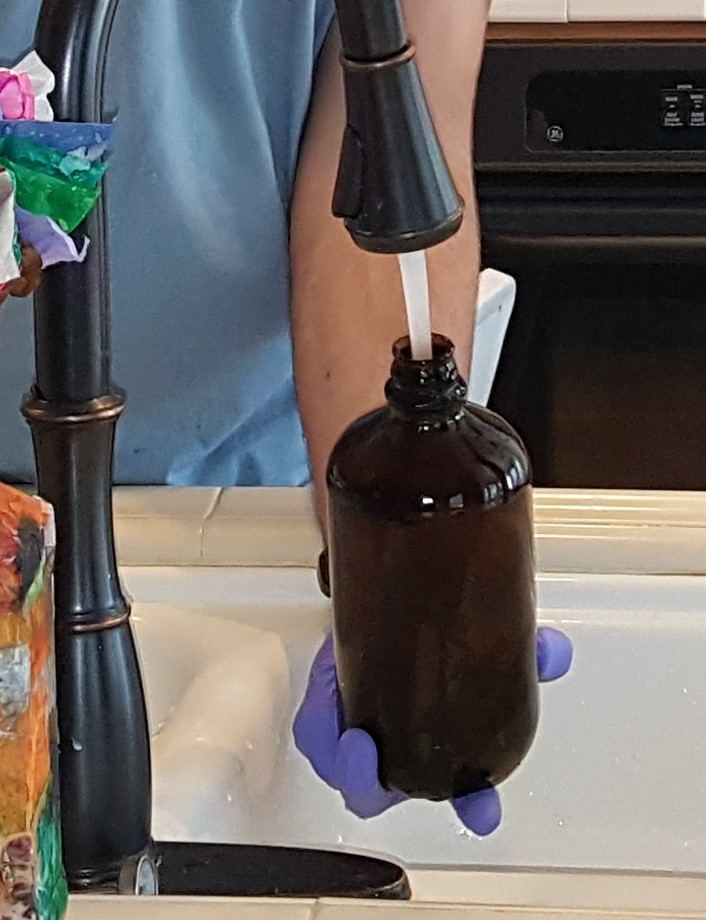 Filling a sample bottle at a kitchen tap. Photo: U.S. Geological Survey (public domain).
How often to test
| Source | Every year | Less often / once |
|---|---|---|
| CDC (2024) | Total coliform, nitrate, TDS, pH | — |
| EPA (2026) | Total coliform, nitrate, TDS, pH | — |
| Penn State (2025) | Total coliform, E. coli | Every 3 years: pH, TDS; iron, manganese near mining; nitrate, pesticides near farms |
| Minnesota Dept. of Health (2026) | Coliform bacteria, nitrate | Once: arsenic, lead; manganese before a baby drinks the water |
| Nebraska Extension (2026) | Nitrate, coliform (E. coli) | Arsenic, uranium, manganese, selenium; lead from plumbing |
Safe plan: bacteria, nitrate, pH and TDS every year, plus whatever your health department flags locally (CDC). Test more often with children, elderly, pregnant or nursing people at home (EPA).
Add tests for your situation
| Your situation | Add these | Example package at Penn State’s lab |
|---|---|---|
| Pregnancy, baby or child at home | Nitrate; manganese before a baby drinks the water (MN) | WD04 Agriculture/Septic, $70 |
| Farms, livestock or septic nearby | Nitrate; pesticides (Penn State) | WD04, $70 |
| Mining nearby, past or present | Iron, manganese, aluminum, sulfate | WD05 Mining, $80 |
| Gas or oil drilling nearby | Barium, chloride | WD06 Gas/Oil Drilling, $75 |
| Arsenic- or uranium-bearing rock | Arsenic; uranium (Nebraska) | WD07 Trace (includes arsenic), $130 |
| New smell, stains or taste | Hardness, iron, manganese, copper; sulfur if rotten eggs | WD02 Aesthetics/Corrosivity, $85 |
| Flooding, digging or a waste site nearby | Total coliform / E. coli at minimum | WD01 Standard, $60 |
| Old plumbing, lead worries | Lead, first-draw sample | WD03 (first-draw and running lead), $125 |
Penn State lab prices, checked 2026-10-05. Your state’s labs will differ.
Home kit or certified lab?
| Home strips / DIY kit | Mail-in certified lab kit | Local certified lab (drop-off) | |
|---|---|---|---|
| Certified? | No | Yes, if certified for your state and tests | Yes |
| Use for | Checking treatment (Nebraska: nitrate strips before and after an RO membrane) | No lab nearby | Yearly tests; bacteria (same-day drop-off) |
| Not for | Health decisions | Bacteria, if shipping can’t meet 30 hours | — |
Penn State: “be cautious of water test results from any uncertified lab or from water treatment salespeople.” Get a certified test before buying equipment.
Find a lab: ask your county or state health department for a list (CDC), or use EPA’s links to state certification programs. EPA does not test home water. Check the lab is certified for your tests.
Find the official list for your state: certified labs by state.
What a lab test costs
Each lab’s own prices, not averages. Wisconsin labs are from Door County’s list.
| Lab | Bacteria | Nitrate | Arsenic | Lead | Package | Turnaround |
|---|---|---|---|---|---|---|
| Penn State AASL | In every package | WD04 $70 incl. standard tests | WD07 $130 incl. 8 metals | WD03 $125 | WD01 Standard (coliform, E. coli, pH, TDS) $60; WD08 (16 parameters) $220 | 10–14 business days |
| Analytichem, WI | $30 yes/no; $38 count (MPN) | $30 | $32 | $32 | Complete Home Owners $225 | Bacteria usually overnight; package 7–10 days |
| UW-Oshkosh ERIC, WI | $25 | $25 | $30 | $35 | Homeowner’s $75 | 3–5 days (bacteria); 7–10 days |
| Baileys Harbor WWTP, WI | $30 | $50 | $55 | — | Homeowner’s $110 (incl. $30 shipping to UW-Oshkosh) | 4–5 weeks (except bacteria) |
| Ephraim Well Water, WI | $30 | — | — | — | — | Usually overnight |
Prices as listed 2026-10-05. Some health departments test free (EPA); in Wisconsin, ask about WellTAP (Door County).
Take the sample
Refrigerate all bottles; ship together (Penn State lab).
- Bacteria: indoor faucet, aerator off; run cold water about 5 minutes. Fill the sterile bottle to the 100 mL line; leave any tablet or powder in. Lab must get it within 30 hours, by Thursday.
- Chemistry (pH, TDS, nitrate, metals): run 5 minutes, rinse the bottle 3 times, fill to the top.
- Lead: don’t flush. First water in the morning from your drinking faucet, after at least 6 hours unused.
Bacteria deadlines differ: federal rule 30 hours, below 10 °C (50 °F); Penn State lab 30 hours; Penn State Extension 24 hours. Follow your lab. Sample early in the week.
What your results mean
| Result | EPA limit | Do this first |
|---|---|---|
| E. coli present | Any positive (health) | Use another source; call your health department. Options (MN): disinfect the well, call a well contractor, or treat. Retest |
| Total coliform present | — (indicator; health) | Same; ask whether to disinfect and when to retest |
| Nitrate (as N) | 10 mg/L (health) | Above it: none for infants under 6 months (EPA); use another source; retest |
| Arsenic | 0.010 mg/L (health) | Drink from another source; retest before choosing treatment |
| Uranium | 30 µg/L (health) | Same as arsenic |
| pH | 6.5–8.5 | Add corrosivity and copper/lead tests (Penn State WD02/WD03) |
| TDS | 500 mg/L | Test what makes it up (hardness, chloride 250 mg/L, sulfate 250 mg/L) |
| Iron | 0.3 mg/L | Stains and taste; treatment depends on level |
| Manganese | 0.05 mg/L | Minnesota: test at least once before a baby drinks the water |
pH, TDS, iron and manganese limits are guidelines, not rules. Check your report in the well water test results tool. Health department and retest first; then see the well water filtration system guide.
FAQ
How often should well water be tested? Yearly for coliform bacteria, nitrate, TDS and pH (CDC; EPA). Also after flooding or well work, if taste, color or smell changes, or when someone is pregnant or a child moves in.
Are home well water test kits accurate? They only screen. Nebraska Extension: kits “are not a substitute for certified laboratory analysis”. Use strips to check treatment equipment between lab tests.
How much does it cost to test well water? Penn State’s lab: $60 basic, $220 for 16 parameters. Wisconsin labs: bacteria $25–$38, homeowner packages $75–$225. Some health departments test free.
Sources
- CDC, “Well Water Testing Guidelines” (last reviewed 2024-07-01)
- U.S. EPA, “Protect Your Home’s Water” (Private Drinking Water Wells), updated 2026-02-26
- U.S. EPA, “Potential Well Water Contaminants and Their Impacts”, updated 2026-07-06
- U.S. EPA, “Contact Information for Certification Programs and Certified Laboratories for Drinking Water”, updated 2026-08-11
- U.S. EPA, National Primary Drinking Water Regulations table, updated 2026-08-31
- U.S. EPA, Secondary Drinking Water Standards, updated 2026-05-26
- 40 CFR 141.852(a)(3), total coliform sample holding time (Cornell LII copy)
- Penn State Extension, B. Swistock, “Testing Your Drinking Water” (updated 2025-06-02)
- Penn State Agricultural Analytical Services Lab, Drinking Water Testing (packages WD01–WD08 and prices)
- Penn State Agricultural Analytical Services Lab, “How to Collect a Water Sample
- Minnesota Department of Health, “Well Testing, Results, and Options” (updated 2026-10-02)
- Nebraska Extension, “Nebraska Extension Issues an Important Reminder for Statewide Private Well Drinking Water Testing” (2026-06-17)
- Door County, Wisconsin, “Well Water Test Kits” (lab price listing)
- USGS, “Arsenic and Drinking Water” (2019-03-01)
All sources checked 2026-10-05.
Method: we set five agencies’ testing advice side by side, matched each situation to a lab package, and compared the bacteria holding times the sources give. Lab prices are from the two listings named, as shown on 2026-10-05; they are not national averages. We have not used or compared test kits ourselves.
Editorial note: This page was researched and fact-checked by the County Road Home team against the manufacturer documents and public sources listed above. AI tools assisted with drafting; every number, spec and rule was checked by an editor before publishing. We are not licensed well contractors or electricians — for electrical, gas and water-safety work, use a licensed professional. Found an error? Email hello@countyroadhome.com and we will review it within 7 days. Last checked: 2026-10-05